> For the complete documentation index, see [llms.txt](https://rc.sunbird.org/llms.txt). Markdown versions of documentation pages are available by appending `.md` to page URLs; this page is available as [Markdown](https://rc.sunbird.org/registry/technical-overview/high-level-architecture.md).

# High-Level architecture

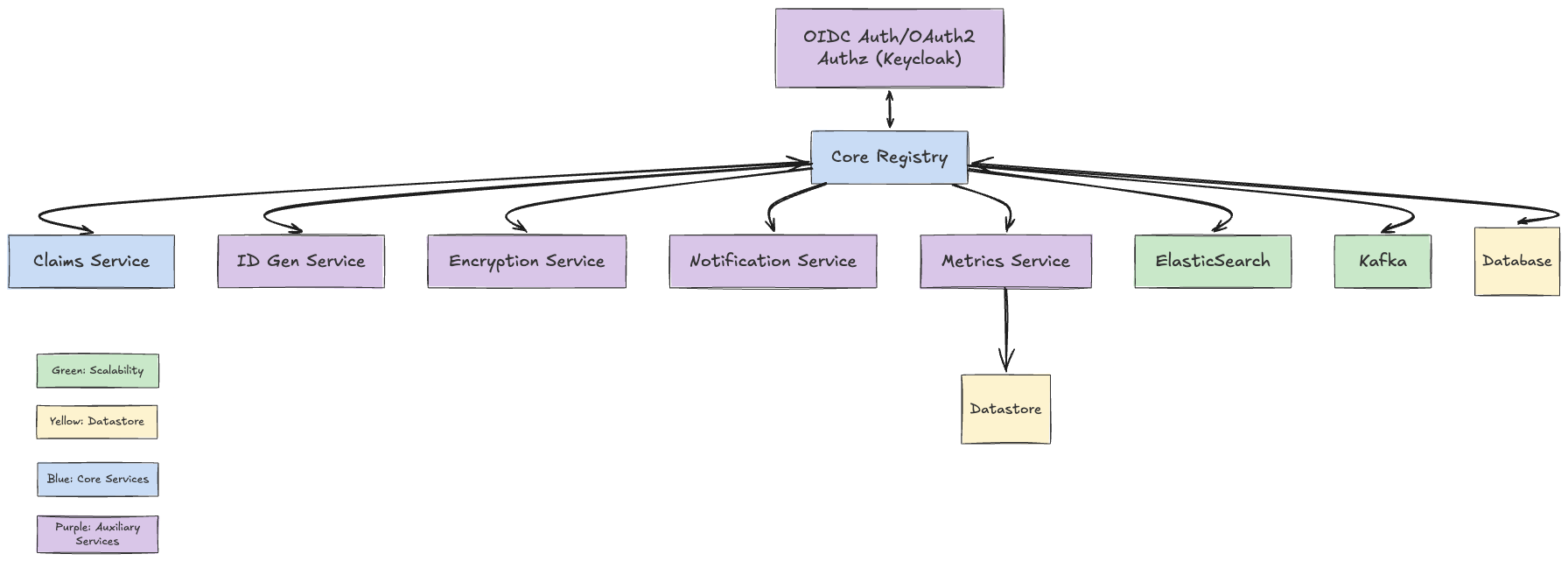
The microservices that make up the Sunbird RC registry, and what each one does.

<figure><img src="https://content.gitbook.com/content/7jgborogcaGcMV6ZkXme/blobs/avbxvqedLTEnR13f1CMv/high_level_diagram_registry.png" alt=""><figcaption><p>High Level Architecture Diagram</p></figcaption></figure>

<figure><img src="https://content.gitbook.com/content/7jgborogcaGcMV6ZkXme/blobs/cmMVenCY1yKW932bQsQl/Artboard%209%20(1).png" alt=""><figcaption><p>Key Services</p></figcaption></figure>

The microservices built as part of Sunbird RC, and their purpose, are explained below.

## At a glance

<table data-search="false"><thead><tr><th width="200">Service</th><th>When you need it</th></tr></thead><tbody><tr><td><strong>Registry (core)</strong></td><td>Always — the core service</td></tr><tr><td><strong>Claim ms</strong></td><td>If attestation or workflows are required</td></tr><tr><td><strong>Notification ms</strong></td><td>To send SMS or email (invites, OTPs)</td></tr><tr><td><strong>Metrics service + ClickHouse</strong></td><td>To capture and query registry events</td></tr><tr><td><strong>DB</strong></td><td>Always — the main data store</td></tr><tr><td><strong>Elasticsearch</strong></td><td>To enable discovery of public data</td></tr><tr><td><strong>Keycloak</strong></td><td>For authentication and authorization (replaceable)</td></tr><tr><td><strong>Kafka</strong></td><td>For asynchronous entity creation under high load</td></tr><tr><td><strong>Encryption</strong></td><td>To store private fields encrypted</td></tr><tr><td><strong>ID Gen</strong></td><td>To generate formatted IDs for schema fields</td></tr></tbody></table>

## Core service

### Registry (core)

The core service that enables the major functionality of Sunbird RC. It exposes APIs to configure schemas and manage entities and workflows, and can create entities synchronously or asynchronously. The registry supports several database providers:

1. Graph database (Neo4j)
2. Relational databases (PostgreSQL, HSQLDB, H2, MariaDB, MySQL, MSSQLServer)
3. NoSQL databases (Cassandra)

The registry dynamically generates REST APIs for the schemas you create, and applies authentication and authorization to those APIs based on the schema configuration. It also provides a discovery API for searching the public data of a particular schema.

{% hint style="info" %}
Elasticsearch needs to be configured with the registry to enable schema discovery.
{% endhint %}

## Supporting services

### Claim ms

Needs to be enabled if attestation or workflows are required. This service handles all the claims of an attestation.

### Notification ms

Sends SMS or emails to users. The registry uses it to send invite notifications, and Keycloak uses it to send OTP messages. It can be configured with third-party plugins to send notifications.

### Metrics service

Handles all the events emitted by the registry through Kafka and stores them in ClickHouse, though the service can also connect to other databases. It exposes an API that returns all the emitted events.

### Encryption

Stores private fields configured in a schema in encrypted form in the database; they can only be decrypted by the encryption service. Enable it through the appropriate environment variables.

### ID Gen

Generates IDs in a given format for any fields in the schema. Provide the format configuration in the schema configuration, and enable the service through environment variables.

## Infrastructure

### DB

The registry requires a main database to store all data. Any of the database providers listed under [Registry (core)](#registry-core) can be used.

### ClickHouse

An open-source database used to store all the events emitted by the registry.

### Elasticsearch

Stores all public data and enables its discovery.

### Keycloak

Enables authentication and authorization of users on the APIs. It can be replaced by any OpenID Connect identity provider and OAuth2-compliant resource server.

### Kafka

Required to create entities asynchronously. If the system needs to handle high load and high availability, entity creation (with credential generation) can be processed asynchronously using Kafka.

## Video walkthrough

{% hint style="warning" %}
This video was recorded on Dec 22 for **v0.0.13**, so some details may differ from the current release.
{% endhint %}

{% embed url="<https://youtu.be/mZjYgdxu0gU>" %}
Video recorded on Dec 22. The video is recorded for v0.0.13
{% endembed %}


---

# Agent Instructions
This documentation is published with GitBook. GitBook is the documentation platform designed so that both humans and AI agents can read, navigate, and reason over technical content effectively. Learn more at gitbook.com.

## Querying This Documentation
If you need additional information that is not directly available in this page, you can query the documentation dynamically by asking a question.

Perform an HTTP GET request on the current page URL with the `ask` query parameter, and the optional `goal` query parameter:

```
GET https://rc.sunbird.org/registry/technical-overview/high-level-architecture.md?ask=<question>&goal=<endgoal>
```

`ask` is the immediate question: it should be specific, self-contained, and written in natural language.
`goal` is optional and describes the broader end goal you are ultimately trying to accomplish on behalf of the user. GitBook uses it to tailor the answer towards what is most useful for that goal.

The response will contain a direct answer to the question and relevant excerpts and sources from the documentation.

Use this mechanism when the answer is not explicitly present in the current page, you need clarification or additional context, or you want to retrieve related documentation sections.
